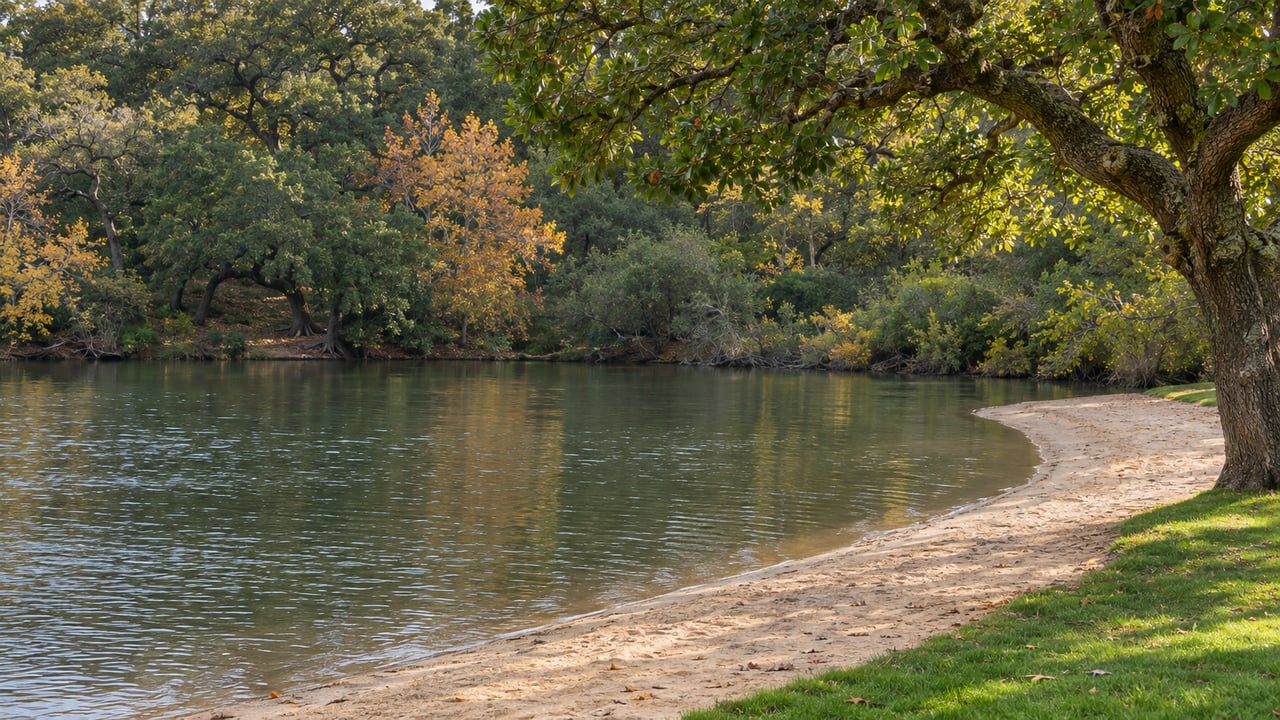
The swim beach at Lake Temescal is closed for the season, and a blue-green algae Danger Advisory is posted for the water. The East Bay Regional Park District plans to reopen swimming in April 2027. Until then the lake is far from idle. This winter the District is working on two of the forces behind the algae advisories. It is removing the lawn that draws Canada geese to the beach, and a design firm has started on the lake's sediment problem. The park is also still open for anglers and walkers.
For Upper Rockridge, the shoreline people walk to in April will look different from the one they left in September. The off-season work explains why.
The lawn beside Temescal Beach is being turned into sand
The East Bay Regional Park District's lawn removal project page states the plan simply. The grass next to Temescal Beach will be replaced with sand, and once the work is done "the beach area will consist entirely of sand."
The reason is geese. The District says Canada geese like open lawns near water because the grass gives them food and the lake gives them a quick way to escape predators. That made the Temescal Beach lawn a natural gathering spot for resident geese. Goose droppings carry nitrogen and phosphorus, the nutrients that feed harmful algal blooms. They can also carry bacteria and other pathogens, which matter most where people swim.
So the lawn work and the algae advisory are the same problem. The District expects to finish before the 2027 swim season. A patch of grass is the cheapest cause to remove. The next cause is much harder.
A lake that has lost most of its depth
Lake Temescal began as a water supply. Anthony Chabot dammed Temescal Creek in 1868 to supply drinking water to the growing East Bay. In 1936 the Temescal Regional Recreation Area opened as one of the first three parks in the East Bay Regional Park District. Today the lake covers about 10 acres inside a 48-acre park.
Since then, Temescal Creek and Caldecott Creek have been carrying sediment into the lake. The figures in a District staff report from September 2026 show how much depth that has cost:
| Point in time | Approximate maximum depth |
|---|---|
| 1868, when the dam was built | 60 to 80 feet |
| 1979, after the most recent dredging | about 20 feet |
| Today | less than 16 feet |
Sediment came in fastest in the 1960s and 1970s, at 5,000 to 10,000 cubic yards a year. Since 1979 the rate has dropped to about 1,000 cubic yards a year, roughly 0.06 feet of depth per year. The slower rate still adds up. The 1979 dredge left the lake about 20 feet deep, and today it is under 16.
Depth matters for algae because a shallow lake warms faster. The District's water quality project page says warmer water, combined with nutrients from storm runoff and from the sediment itself, creates good conditions for blue-green algae. Runoff reaches the lake from nearby homes, Highway 24 and the Caldecott Tunnel, all of which were built long after the reservoir. The staff report adds that the shallow lake allows nutrients to be released from within it, while Caldecott and Temescal creeks keep bringing more in.
The District has been treating the problem for years. It has carried out nine in-lake phosphorus treatments and installed an Oxygen Saturation Technology system, and it completed an updated bathymetric survey of the lake bottom in 2024. The algae advisories have kept coming back anyway, and that is why the District reopened the larger question of dredging this year.
September's vote, and the cost it is trying to bring down
In 2019 the District studied what a full fix would involve: large-scale dredging, treatment wetlands, bigger sediment basins and oxygenation. The estimated cost was $19.7 million to $24.4 million in 2019 dollars, and the park would have had to close for several years.
The current effort aims to find a version the District can afford and park users can live with. In December 2025 the Board set aside $800,000 for planning and design. The District says the goal is a feasible, cost-effective way to dredge that also reduces costs and disruption to visitors. Preliminary design work would also put the District in a position to apply for state and federal grants. The firm was chosen in two stages:
- An open Request for Proposals drew four proposals.
- Three of them, Moffatt & Nichol, Balance Hydrologics and Stillwater Sciences, each received a $10,000 contract to evaluate restoration options, missing data and ways to reduce cost.
- After reviewing that work, a selection committee recommended Moffatt & Nichol of Walnut Creek for the second stage: targeted technical analysis, preliminary design and a design report.
At its September 1, 2026 meeting, the Board of Directors approved the $670,000 contract by a vote of six to zero. The director who made the motion asked to receive an update before the preliminary design goes forward. The staff report describes the purpose of the work as finding strategies:
"to maintain swimming, fishing, and open-water aesthetic recreational values of the reservoir, while addressing historic and persistent challenges related to sedimentation, elevated nutrient levels, and algal blooms."
After the contract, $100,000 of the $800,000 budget remains. The District's timeline has preliminary design and the financial analysis finishing in December 2027, and the District says that timeline may change. Any dredging would come after that. Swimmers coming back in April 2027 will return to a sandier beach on a lake that is still shallow.
What the lake offers in the meantime
None of this closes the park. The gates are open from 8 a.m. to 10 p.m., and the park itself is open from 5 a.m. Winter is the season for anglers.
- Trout. The District's fish-planting schedule for October and November 2026 included 1,000 pounds of trout for Temescal during the week of November 2 to 6, depending on weather. Anglers 16 and older need a California fishing license and a $5 daily EBRPD fishing permit. The District-wide daily limit is five trout.
- The loop. The Temescal Loop Trail is 0.93 miles with 20 feet of elevation gain and a maximum grade of 3 percent.
- Parking. The $5 vehicle fee in the North Lot applies on weekends and holidays from April through October.
- The Beach House. The building opened to the public in 1940. It was built by the WPA, originally with changing rooms downstairs and the Park District's headquarters upstairs. Today it holds 80 seated or 130 standing guests. On December 1, from 4 to 7 p.m., the District is holding an open house at the Temescal Beach House where Park District staff will be on site to answer questions. No caterers will attend.
For dinner after the loop, Chez Maeju opened in September at 6200 Claremont Ave. It is chef Sujin Kim's Korean restaurant built around fermentation, and in mid-October The Oaklandside reported it was serving dinner only.
Lake Temescal is part of what makes Upper Rockridge feel the way it does. When the beach, the water and the plans for both change, that matters to people who live nearby and to people thinking about moving here. Dan Walner follows these changes closely. If you would like to talk through how Lake Temescal's next few years could affect a home near the lake, please request a confidential market consultation.